Index

Click on subject of interest shown on the right under the heading "labels" to see all relevant posts

To look at letters (and some replies) sent to politicians and newspapers, scroll down the index on the right hand side and select the appropriate heading.

Note the blog allows multiple labelling and all letters to politicians are under "letters to pollies".

If you scroll down and cannot go further, look out for icon "Older Posts". Click on that to continue


26.10.22

Slow start to New Zealand refugee resettlement

It is now six months since the previous federal government finally accepted the New Zealand government’s offer to resettle 450 of Australia’s refugees over three years, an offer that had been on the table for almost a decade. Yet, at the time of writing, not a single refugee has been resettled in New Zealand. There are some thirty-six refugees whose applications are currently under consideration, but, so far, less than half of them have even been interviewed. The main problem, according to the United Nations High Commission for Refugees, is that, after up to a decade of punitive incarceration on Nauru, Manus island and  other detention centres in Australia, many of the refugees are in such a poor mental state that they are simply not able to engage with the application process. Emily Chipman, at the UNHCR, stated: “The mental health impact of what these individuals have experienced has significantly affected their capacity to engage in the resettlement process and has led to a general lack of confidence. Refugees have evoked concerns about leaving family members behind in Australia, and about not being psychologically strong enough to rebuild their lives in another country.”

In addition, a number of the refugees are awaiting the outcome of their applications for resettlement in Canada or the US, and are therefore not eligible to apply for resettlement in New Zealand.

What is clear is that these people require intensive mental health support in order to
successfully navigate the resettlement process. Given that it is the Australian government that is directly responsible for their terrible suffering, then it should urgently take the necessary steps to put in place the resources required to get the resettlement programme on track. That is surely the least our government can do after inflicting so much harm on these people, who were forced to flee their homelands in search of a safe haven.

Mike Griffin

17.10.22

National RAR update. October 2022


11th October 2022

Hello to all RAR Members and Supporters – welcome to the latest RAR update.

National RAR Conference – Draft Report

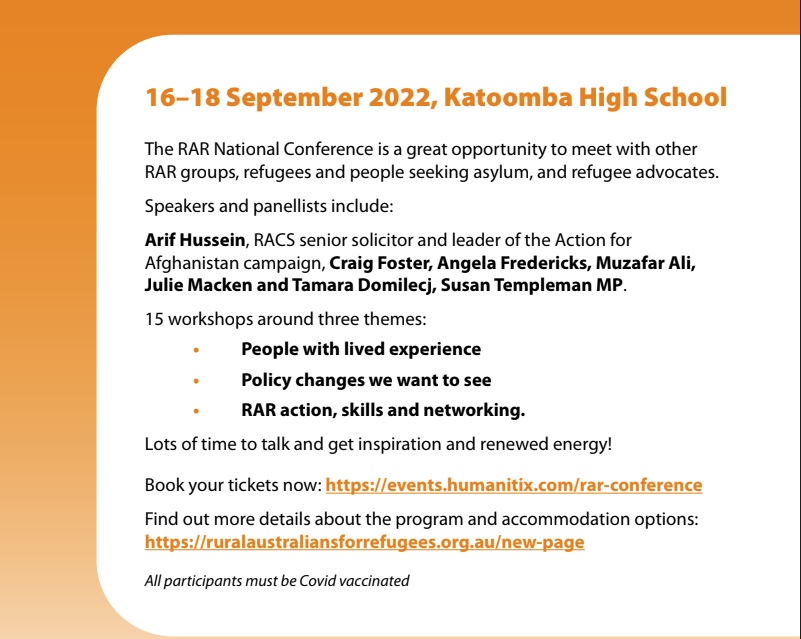
The first Rural Australians for Refugees (RAR) national conference in four years came together over September 16–18 at Katoomba. Our successful, indeed inspiring, conference is to the credit of the Blue Mountains Refugee Support Group and all the participants.

More than 150 people from towns and regions throughout eastern Australia attended what was probably the first grassroots refugee rights conference since the pandemic.

The conference confirmed what was a common view emerging from discussions beforehand - that the Anthony Albanese government is not meeting the movement’s fundamental aims.

Members of refugee-led organisations, such as Cisarua Learning and Women for Change, and others with lived experience of seeking asylum helped identify and work out what needs to be done to change that.

At the conference there was support for Action for Afghanistan’s call for another 20,000 emergency visas for refugees from Afghanistan, and for ending offshore detention and mandatory detention — which averages more than two years — and to resolve the issue of statelessness that has meant a number of refugees have been detained for a decade or more.

Another issue which we discussed and which gained support was the lifting of the ban on the refugees who arrived in Indonesia after July 1, 2014 from applying for visas under the humanitarian program. We joined with other refugee rights activists in wanting all refugees on temporary visas to be granted permanent visas without delay and for all those seeking asylum to have access to work and study rights, and to Medicare.

A call for a Royal Commission into immigration detention, which would have powers to investigate the contracts for private companies to run the camps and to protect the refugees who want to speak out, also received broad support.

Besides highlighting the directions we will want to go in, the conference was an opportunity to learn new campaign skills and to start to consider how to strengthen unity in the movement towards achieving our goals.

Conference delegate Katherine Morrison, from Bellingen, commented: “The conference was well organized with a good and varied programme. We participants were encouraged to circulate and get to know members from other RAR groups and the speakers who sat amongst us. I found the conference well worth attending.”

A Conference Declaration is being drafted after a working session at the end of the conference, and a fuller conference report will be produced soon.

RAR annual general meeting

RAR’s Annual General Meeting was held in Katoomba on Friday September 16. Many attended in person – more than originally hoped for as more people signed up for the Conference at the last minute and came to the Blue Mountains - and a number of groups joined in by Zoom.

The AGM received an Annual Report from outgoing President, Louise Redmond, a report from the Afghanistan sub-committee presented by Marie Sellstrom, and a 2021-22 financial report from Treasurer Geoff Bryne. The AGM also adopted a revised 10-point plan, in particular adding a call for a just and efficient immigration process for those seeking asylum. All these documents can be found on the RAR website at https://ruralaustraliansforrefugees.org.au/about-us.

The AGM also elected a new National Committee:

President: Jonathan Strauss, Cairns for Refugees (QLD)

Secretary: Rosemary Bishop, Blue Mountains Refugee Support Network (NSW)

Vice-President: Paul Dalzell, Alexandra RAR (Vic)

Treasurer: Geoff Byrne, Southern Highlands RAR (NSW)

Communications Convenor: Kat Vella, Griffith RAR (NSW)

Committee members: Marie Sellstrom, Mansfield RAR (Vic); Louise Redmond, Blue Mountains Refugee Support Group (NSW); Katherine Stewart; Warrnambool RAR (VIC)


Left to right: Rev Paul Dalzell, Geoff Byrne, Rosemary Bishop, Marie Sellstrom, Jonathan Strauss, Louise Redmond, Katherine Stewart, Kat Vella.

Minutes will be circulated to members shortly.

Calling for volunteers

Are you passionate about RAR's advocacy and want to contribute to reaching a wider community? The RAR National Committee is looking for volunteers to contribute to two larger communications projects in the coming year (see below). 


1) COMMUNITY STORIES

Combine your passion for advocacy and writing through connecting with the RAR community all over Australia to interview people and share their stories on the new RAR website blog. You will assist the Communications Convener to source interviewees, draft questions and take part in interviewing people to then publish stories online. No formal writing experience necessary. Time commitment is open and negotiable.

2) INSTAGRAM

Join the small Instagram team on the national committee to help connect a broader audience to RAR's advocacy work and mission. You will help draft copy for posts, design graphics (if you want to, otherwise this is optional), source images and video that works to RAR's social media strategy. No previous Instagram experience is necessary but it is preferred. Training and support will be provided. Time commitment is open and negotiable.


If interested or you would like to know more, please contact Kat Vella, RAR Communications Convener on 0426 953 698 or email rarcommsconvener@gmail.com.


Please help us to assist Afghan People in Danger.

The recent Kaaj Tution attack in Kabul where 57 young students were killed by the Taliban has demonstrated to us the brutality of the Taliban and the precarious lives for Afghanistan people particularly Hazaras.  The Hazaras have suffered genocide from the 1890s and it must stop.

It will take greater power than the RAR to achieve this but we can make a small contribution.  RAR members are sponsoring over 90 families, the majority of whom are Hazara. Ten of the families being sponsored have been moved to Pakistan and Iran because they were in extreme danger in Afghanistan and were in hiding.  This means that we had received evidence that the Taliban were searching for them to execute them.

Many of the sponsors are sending money to the families they are sponsoring to buy food because they are being refused the opportunity to work.  In the case of the families who are in Iran and Pakistan RAR is helping members to pay for visas and visa extensions which are very expensive.  (100s of dollars).  RAR groups are raising money to pay for living expenses as these families had to leave Afghanistan with no money and in some cases no documents. 

In September 2021 when the Taliban took over Afghanistan RAR members who were not sponsoring families very generously donated money to support our Afghan brothers and sisters.  RAR funds to support these families are now running low.  We are asking members to open your hearts, if you are able, to help keep the people we are sponsoring safe and help them to eventually reach Australia.

Marie Sellstrom

Convenor Afghan Sponsorship

0417398528


Positive vibes from meetings with Immigration minister Andrew Giles

Refugee and asylum seeker advocates are reporting positively on their engagement with Andrew Giles, stating recently that there are now encouraging signs that more people who are assessed as low risk are being released into the community. In an interview with Guardian Australia, the minister emphasized that the government “is committed to ensuring humane and risk-based immigration detention policies. If there are no security or safety concerns, individuals should be living in the community until a durable solution is found.”

It appears that the minister is now taking positive steps to honour the commitments made by Labor prior to the federal election. Hannah Dickinson, the ASRC’s principal solicitor has welcomed the change in direction, stating: “We have been encouraged about the pragmatic, humane decision-making in releases from detention since May. It’s slow but encouraging – we’re optimistic.”

We need to keep up the pressure to ensure that the detention of asylum seekers becomes a last resort, not a starting point. Every day that an asylum seeker or refugee remains in detention is a day too long. They have suffered enough, and the government needs to urgently allocate the necessary resources to allow them to live safely in the community.


Slow start to New Zealand refugee resettlement

It is now six months since the previous federal government finally accepted the New Zealand government’s offer to resettle 450 refugees over three years, and yet, at the time of writing, not a single refugee has been resettled. There are some thirty-six refugees whose applications are currently under consideration, but, so far, less than half of them have been interviewed. The main problem, according to UNHCR, is that, after up to a decade of punitive detention, many of the refugees are in such a poor mental state that they are simply not able to engage with the application process. Emily Chipman, at the UNHCR, stated: “The mental health impact of what these individuals have experienced has significantly affected their capacity to engage in the resettlement process and has led to a general lack of confidence. Refugees have evoked concerns about leaving family members behind in Australia, and about not being psychologically strong enough to rebuild their lives in another country.”

In addition, a number of the refugees are awaiting the outcome of their applications for resettlement in Canada or the US, and are therefore not eligible to apply for resettlement in New Zealand.

What is clear is that these people require intensive mental health support in order to successfully navigate the resettlement process. Given that it is the Australian government that is directly responsible for their terrible suffering, then it should urgently take the necessary steps to put in place the resources required to get the resettlement programme on track.

29.9.22

Lisa organised a fabulous fundraising concert for our local RAR group.

The audience before the first act in this rural, heritage hall.


"We had a wonderful fundraiser at Raleigh village hall on Sunday. A packed hall enjoyed the Sawtello Gospel choir, singer-songwriter Stewart Peters, and the Honey Barbara Ensemble. Huge thanks to all the performers, to Lisa who organised the concert and to our great band of volunteers who provided refreshments and made it all happen on the day. The outcome is that we have donated $3,500 to the Asylum Seekers Centre in Newtown."

The Choir

The ensemble

The raffle ticket sellers

The goodies.

 Contact us via this blog or approach us at one of our market stalls. Join a group dedicated to working as a rural team for refugees.

5.9.22

'HOME TO BILOELA AT LAST' by M. Griffin

 Soon after the federal election in May, the new Labor government kept its promise to allow the Murugappan family - parents Nades and Priya, and children Kopita and Tharnicaa – to return home to Biloela in Queensland. It was a day of jubilation and celebration for the Biloela community, and, inevitably, a great photo opportunity for our political leaders to share the limelight. Since then, as expected, the family has been granted permission to remain permanently in Australia. After four years of detention, including a lengthy stay on Christmas Island, the family can now rebuild their lives in the town that had previously welcomed them with open arms.

Looking back, it seems incomprehensible that the Coalition government would spent upwards of $50 million on its ideological and inflexible pursuit of this family. Even Barnaby Joyce, who at the time was the leader of the Nationals and Deputy Prime Minister, was of the view that his government’s position made no sense. He pointed out that the two girls were born in Australia, and that common sense should prevail. Our local MP, Pat Conaghan, however, took a different stance. He argued that the family had had their days in court, had not been able to establish that they were genuine refugees, and that they should not therefore be afforded special treatment. In other words, they should have been deported to Sri Lanka.

In the end, human compassion and common sense prevailed, and the Minister used his discretion, as he is entitled to do, to grant the family permission to remain permanently in Australia.

The Murugappan family are, of course, the lucky ones. There are thousands of other refugee families who have been living in Australia for up to ten years, including children who have been born here, but who, so far, have no certainty about their future. Most of them have been recognised as genuine refugees, who are therefore entitled to our protection under international law, yet they have only been issued with temporary visas, which makes their live very precarious. It is more difficult for them to find permanent employment, it’s impossible for them to get a mortgage, and their children are not able to access student loans to enable them to progress to tertiary education. They live their lives in permanent uncertainty, which inevitably has a serious impact on their health and wellbeing.

The government did the right thing by the Biloela family. It’s now time to step up and grant permanent residency to the many refugees who have proven that they want to work and contribute to Australian society.  It should be a no-brainer.

30.8.22

An unsatisfactory response from the Minister for Home Affairs and Minister for Cyber Security, the Hon Clare O’Neil MP

4 National Circuit Barton ACT 2600
PO Box 25 Belconnen ACT 2616 • Telephone: 02 6264 1111 • www.homeaffairs.gov.au
Ref No: MC22-037001

Dear Mr Griffin


Thank you for your correspondence of 31 July 2022 to the Minister for Immigration,

Citizenship and Multicultural Affairs, the Hon Andrew Giles MP, concerning Australia’s regional processing arrangements on Nauru and resettlement outcomes for people under those arrangements. Your correspondence has been referred to the Minister for Home
Affairs and Minister for Cyber Security, the Hon Clare O’Neil MP, as matters relating to regional processing fall within her portfolio responsibilities. The Minister appreciates the time you have taken to bring this matter to her attention and has asked that I reply on her behalf.


The Australian Government is committed to delivering an orderly migration programthrough legal pathways to Australia, under robust migration and humanitarian programs. The Government is also taking a strong stance against people smugglers who exploit vulnerable migrants in trying to sell irregular passage to Australia.


The Government is concerned that people smugglers remain poised to prey on and exploitvulnerable potential irregular immigrants for their own personal gain. As such, we have
committed to maintaining Operation Sovereign Borders, including regional processing
arrangements in Nauru, which has successfully stemmed the flow of irregular maritime
ventures to Australia, disrupted people smuggling operations in the region, and prevented
unnecessary deaths at sea. Under this approach, people who attempt to travel to Australia
irregularly by boat will not be settled in Australia.


Regional processing arrangements provide people with the opportunity to have their
protection claims assessed by the Government of Nauru, and for those found to be in need
of international protection, resettlement in a third country. People under regional
processing arrangements are not detained and are accommodated in the Nauruan
community with access to health and welfare services. Those brought to Australia for a
temporary purpose will remain in Australia until the purpose for which they were brought
has concluded. During their temporary stay they receive accommodation and access to
health and welfare support. People residing temporarily in the community on bridging visas
have work rights and access to Medicare.

The Government is committed to finding durable migration outcomes for people under
regional processing arrangements. The Government will continue to support the
implementation of third country resettlement arrangements with the United States, with
over one thousand people having already been resettled, and New Zealand, which has
commenced processing, with first resettlements expected by the end of this year.
Assistance is also available for people to return home voluntarily.


The Government of Nauru has a coordinated response in place to deal with the COVID-19
pandemic and the recent community outbreak. All transitory persons in Nauru reside in the
local community and the Nauruan government has implemented measures to mitigate the
spread of COVID-19 in the community, similar to those implemented in many countries,
including Australia.


Australia supports the Government of Nauru to provide transitory persons with access to a
variety of health and welfare services, which have been supplemented during the
COVID19 pandemic to mitigate risks of health, personal safety and access to food during
periods of imposed restrictions.


Freight flights and vessels continue to deliver supplies to Nauru. Where a transitory person
is required to self-isolate or quarantine, Department of Home Affairs service providers, in
liaison with the Government of Nauru, provide additional health and welfare supports as
required, including contactless delivery of medication, any household supplies and food.
The Government strongly encourages people in the regional processing cohort to engage
with third country migration options available to them as these options provide the best
available opportunity to start the next phase of their lives.


Thank you for raising these matters with the Minister.
Yours sincerely
BJ
A/g Director
Regional Processing and Resettlement
Department of Home Affairs
23 August 2022

22.8.22

Letter to PM Albanese, " Take the necessary steps to bring offshore processing to an end.."

                                                                                                                                                                                        Valla Beach

                                                                                                 NSW 2448

                                                                                                 16th August 2022


Dear Mr. Albanese.

Please find enclosed an open letter, addressed to you, and signed by 706 people who have visited our Rural Australians for Refugees market stalls in recent weeks.

The letter reads:

Dear Mr. Albanese,

We, the undersigned, are encouraged by the prospect of a more humane and compassionate treatment 

of asylum seekers and refugees under your government. Your commitment to grant permanent protection to the 19,000 refugees currently in Australia on temporary visas (TPVs and SHEVs) is most welcome. We urge you to go further:

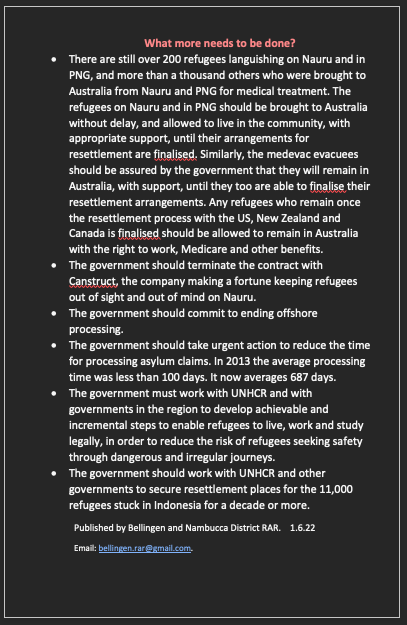
·      Bring the 200+ refugees remaining on Nauru and in PNG to Australia to live in the community whilst their resettlement arrangements are finalised.

·      Terminate the contract with Canstruct without delay.

·      Reassure the 1000+ medevac refugees in Australia that they can remain here, living in the community, with work rights and other benefits until arrangements for their resettlement are finalised.

·      Take the necessary steps to bring offshore processing to an end.

It is now almost three months since the people of Australia voted for a more humane and compassionate approach to refugees and asylum seekers. It would be encouraging to us all to see some concrete evidence that your government is making good on its election promises. We also urge you do more, much more, to end the suffering inflicted by almost a decade of punishment and mistreatment of the people who have sought our protection. It is surely time to bring this shameful chapter in our history to an end.


Yours sincerely,

Mike Griffin

Bellingen and Nambucca District RAR.

29.7.22

What future for detainees on Nauru?

In recent months, the terrible war raging in Ukraine has never been far from the daily news headlines. 


The Russian invasion, and the subsequent enormous destruction and loss of life, has been widely, and rightly, condemned by the world at large. Millions of Ukrainians have been either internally displaced or have fled to safety in other countries. 


Our government has commendably played its part, and to date has welcomed several thousand Ukrainians. They have been granted temporary, three-year humanitarian visas, which allow them to work, to study, to access Medicare and other benefits. The assumption is that, once peace returns to their homeland, they will choose to return home. In the meantime, they are safe from danger and are being generously supported by their local communities.


Sadly, it is a very different story for many others who have fled war and persecution in their home countries, and who have sought safety on our shores.


Let’s look at the tiny island of Nauru, situated in the middle of the Pacific Ocean, and home to fewer than 11,000 people. For almost ten years, our government has used the island as a place of detention for many hundreds of asylum seekers. 


Billions of dollars of taxpayers’ money have been spent in keeping them out of sight and out of mind. They have been subjected to terrible mistreatment and abuse, which has been widely documented. Today, just 112 asylum seekers and refugees remain on the island, but their situation is dire, and made much worse in recent weeks by an outbreak of COVID, which has infected almost half the population.


There have been many calls to bring these remaining people to Australia, pending their resettlement in New Zealand, Canada, or the US. Advocates are urging the government to allow them to come here, to offer them the medical and other support that they need and to reassure them that they will remain here in safety until their arrangements for resettlement elsewhere are finalised. It is a request that makes good sense.


 It makes no sense at all for the government to spend $4 million a year for each detainee on Nauru, when they could be accommodated in Australia for a tiny fraction of that sum. Detaining people indefinitely causes enormous mental and physical harm, and has caused enormous damage to our international reputation. But that’s politics!


Michael Griffin


Letter to Minister Giles

 Sent: Friday, July 29, 2022 10:42 AM


To: 'Andrew.Giles.MP@aph.gov.au' <Andrew.Giles.MP@aph.gov.au>
Subject: Refugees on Nauru


Dear Minister Giles,

The election of a Labor government was  very positively received by the many Australians who have been campaigning for years for a more compassionate and humane approach to the treatment and resettlement of refugees. They have endured almost a decade of cruel and inhumane treatment which has resulted in suicide, self-harm and serious mental health issues. It’s surely time to put this shameful chapter in our history behind us.

There are currently approximately 120 refugees and asylum seekers languishing on Nauru, which is in the midst of a serious COVID outbreak.  Food and water are becoming scarce and expensive. The refugees are expected to live on an allowance of $200 a fortnight, whilst Canstruct continues to make millions from their misery. This is a terrible and completely unnecessary situation.

I urge you and your government to take immediate steps to bring this group of people to Australia, whilst arrangements for their resettlement in more generous countries can be finalised.  They can live in the community, with appropriate rights to work, education and Medicare for a tiny fraction of the $4 million per person  of taxpayers’ money that is currently squandered each year on keeping them out of sight and out of mind.

Please bring them here, and reassure them that they can remain in Australia until their resettlement arrangements are finalised.

I look forward to your positive response.

Yours sincerely,

Mike G.

Valla Beach, NSW 2448

19.7.22

Proposed National Conference in Katoomba, 16-18 September 2022


Dear RAR groups,


The Blue Mountains Refugee Support Group offered to host the 2020 National Conference and as we all know, it was postponed because of the Covid outbreak.  Early this year, we decided that it was safe to try again.  With fewer people.  We are now prepared to revise downwards our expectations of attendance - aiming for 200, in a large school, with plenty of opportunities for small group work and social distancing when we are in the school hall.


We want to go ahead with the conference, if it's safe to do so.  We have a great mix of speakers and panellists, and 15 small group workshops to choose from.  We have an 'open session' at each of the three breakout sessions. But most importantly, this conference will be held 118 days after the Albanese Government assumed office on 22 May.  We want this Government to know that we are watching them and we expect positive change.  Coming together as a national body is a powerful way to make our presence felt.  


We have invited the Minister for Immigration to attend - but no response yet.  (The Minister for Home Affairs is not available).  This coming year is vitally important after 21 years of lobbying and advocacy.  We cannot rest now that we have an ALP government.


So I'm asking you to promote the conference among your members and encourage people to register in the coming weeks, if they plan to attend.  Katoomba has many tourists, and accommodation may be hard to find at the last minute.  We need to know if there is sufficient interest in holding the conference at this time. 


I attach a flyer, and ask that you circulate this through your members and other refugee advocacy groups you may be connected with.  While this is a RAR conference, we welcome people from other like-minded groups attending.


The latest details of the Conference program is on the RAR website, along with accommodation options.  https://ruralaustraliansforrefugees.org.au/new-page 


(thanks to Carolyn Brooks from Queanbeyan RAR for the flyer and Linda McNeill Castlemaine RAR for the logo).


Warm regards

Louise Redmond

National President

Rural Australians for Refugees on Twitter and Facebook 

RAR is a member of the Australian Refugee Action Network
Rural Australians for Refugees
E: rar.australia@gmail.com

14.6.22

Welcome, strangers: Queen’s Birthday Honour for asylum seeker advocate: The Age

When Sister Brigid Arthur was a teacher at schools in Melbourne’s west, from the mid-1950s to the early 1990s, she was moved by the resilience of local immigrant families.

She saw that with help from the community, they could not just survive but thrive.

Asylum seeker advocate and social justice activist Sister Brigid Arthur.

Asylum seeker advocate and social justice activist Sister Brigid Arthur.Credit:Joe Armao

It’s something she’s seen with many of the thousands of asylum seekers she’s assisted over the past 30 years.

One young woman who came from a war-torn country in 2017 as a teenager, with little education, is now studying for a master’s degree and works in medical research, which was “an amazing turnaround”, Arthur said.

By Carolyn Webb


The life and times of activist Sister Brigid Arthur : The Monthly


Image of Sister Brigid Arthur

© Penny Stephens / The Age

The life and times of activist Sister Brigid Arthur

Twenty years ago, I had reason to visit someone in the Maribyrnong detention centre, in Melbourne’s inner west. The people who sent me told me to meet a nun outside who would introduce me to the detainee. I spotted her in the car park: a small woman, casually dressed and watchful, propped on two crutches. In answer to my query, she muttered something about her hip. After we passed through security – a processing desk, a metal detector and some suspicious looks – we were dumped in an interview room and the door slammed shut behind us. Immediately, the nun began producing an astonishing array of stationery from within her clothing: pens, highlighters, Post-it Notes, paper. “They won’t give them stationery in here,” she said. “And no one pats down a nun.”


September 2021, Essays, Sister acts, By Jock Serong


Go to The Monthly article 


27.5.22

Refugee Council Letter to Prime Minister Albanese


23 May 2022

Hon. Anthony Albanese MP
Prime Minister
Parliament House
CANBERRA ACT 2600

Dear Mr Albanese,


On behalf of the Refugee Council of Australia, I would like to congratulate you on the Labor Party’s election victory on Saturday and your appointment today as Prime Minister. Your pledge on election night to work towards building a nation in which no one is left behind and no one is held back gives greater hope to many Australians that we can collectively work towards building a fairer and more compassionate society.


The past decade has been a tough time for many people who have sought refugee protection in Australia. This is particularly so for the 1,380 people still struggling under Australia’s offshore processing policy, the 19,000 refugees subject to temporary protection, the 30,000 people left with no safety net while they wait interminably for an initial decision on their application for onshore protection and the countless Australians of refugee background who remain separated from close family members, including partners and children.
We particularly look forward to your government implementing its pledge to abolish temporary protection as quickly as possible, to enable the 19,000 refugees affected by this policy to fully embrace the opportunity to make a life-long contribution to Australia. This policy has been particularly unjust, needlessly punishing hard-working people by denying them the certainty of permanent protection from persecution in their home country and preventing them from reuniting with separated family members.


While we strongly disagree with Labor’s offshore processing policy, we will work as hard as possible – as we have done with the previous government – to support practical solutions for the 1,380 people still suffering under this policy after nine years. While we applaud the Morrison Government’s long-delayed signing of the resettlement deal with New Zealand and the resettlement arrangement with the United States, we remain concerned that more than 500 people will be left behind when all resettlement options currently available are exhausted. For our part, we have worked since 2019 with organisations in Canada to raise $4.3 million to support sponsorship applications for 172 refugees and 144 separated family members, providing a pathway for refugees in offshore processing excluded from the US process. Finding answers for all people affected by this damaging policy will take a great deal of effort and considerable flexibility.


We also look forward to your government implementing the Labor Party’s platform to expand the Refugee and Humanitarian Program progressively to 27,000 places per year and build a community sponsorship program of 5,000 places. The recent cuts to the Humanitarian Program and the failure to restore 13,400 visas not issued over the previous two financial years have come at a time when resettlement as a solution for refugees is more needed than ever before. We applauded the Morrison Government’s decisions in March to offer 16,500 additional places over four years for refugees from Afghanistan and to enable Ukrainian citizens to access three years of humanitarian protection in Australia while they wait to see whether safe return will be possible in the near future. These changes were welcome but we know that Australia is well placed to make a more significant contribution to solutions for refugees through resettlement. Over the past 75 years, we have also seen how our important humanitarian contribution through refugee resettlement has benefited our nation in the long term, through the life-long contributions of the 900,000 refugees given new opportunities in Australia.


Our work in refugee resettlement must be backed up by much more effective engagement in the Asia-Pacific region and beyond in efforts to improve the protection of refugees in countries where they first seek protection. The Gillard Government began to expand aspects of this important foreign policy work in response to recommendations of the Expert Panel on Asylum Seekers in 2012 and the lobbying of our organisation and others. Unfortunately, most of this work ceased with the change of government in 2013. The need now is even more pressing to support the work of UNHCR and to engage governments in the region on achievable and incremental steps to enable refugees to live, work and study legally. These basic protection options are essential to providing alternatives to refugees otherwise forced to seek safety through risky and irregular journeys. Our organisation’s close working relationships with NGOs and refugee-led organisations across Asia-Pacific will enable us to do much to assist government efforts to improve constructive regional engagement.


Attention must also be paid to lengthy delays in Australia’s onshore protection process – both the initial decisions by the Department of Home Affairs and review by the Administrative Appeals Tribunal – and the destitution experienced by many people waiting for outcomes as a result of massive cuts to assistance through the Status Resolution Support Services program. Australia’s immigration detention system also needs urgent review. Since Labor was last in office, the average time spent in detention has blown out, from less than 100 days in mid-2013 to 687 days as at January 2022.


The Refugee Council of Australia and our many members and supporters look forward to working with you and members of your team on these and other issues. There is much to be done but the vision you have outlined gives us hope that much can be achieved so that people seeking safety in Australia are not left behind or held back.


Yours faithfully,
Paul Power
Chief Executive Officer

7.5.22

Vote To End the Cruelty to Refugees

The Liberal/National Government has now detained refugees and asylum seekers on Nauru, in PNG and in various places of detention in Australia for just on 9 years. There have been some 14 deaths of detainees mostly by suicide, in Nauru and New Guinea over these years and many more of these people are suffering from serious long term mental health issues

The Government spends more than $4 million per refugee per year to keep 112 refugees out of sight and out of mind on the tiny island of Nauru.  That’s more than half a billion dollars of taxpayers’ money every year!

As the federal election approaches the Government has announced a belated agreement to transfer 450 refugees over 3 years for settlement in New Zealand. The NZ offer has been on the table since 2013. These places offered by New Zealand are not nearly sufficient to assist the 1200 refugees currently requiring a solution to their continuing uncertainty and despair.

These people have committed no crime. They have made often terrifyingly dangerous journeys to escape war, conflict, persecution and torture in their home countries and then simply exercised their legal rights under the Refugee Convention to seek asylum in Australia.

These people should be released into the community where they can live, work, pay taxes and contribute their skills and expertise to our country

At the upcoming election the Coalition parties must be held to account for this expensive, cruel and inhumane treatment of refugees. The Labor Party has also never raised any serious concerns about these draconian Government policies.

At the next election I urge voters to vote for a candidate who will support-

A government that treats asylum seekers and refugees with fairness and humanity

A government which declares  that it will end the mandatory detention of people seeking safety

A government that offers permanent protection to genuine refugees

A government that supports refugees and helps them to rebuild their lives and contribute to our society


Paul Bartholomew

Boambee East