Index

Click on subject of interest shown on the right under the heading "labels" to see all relevant posts

To look at letters (and some replies) sent to politicians and newspapers, scroll down the index on the right hand side and select the appropriate heading.

Note the blog allows multiple labelling and all letters to politicians are under "letters to pollies".

If you scroll down and cannot go further, look out for icon "Older Posts". Click on that to continue


Showing posts with label #asylumseekers. Show all posts

7.10.20

Letter, Oct 6, 2020, from Director Regional Processing and Resettlement Department of Home Affairs for Minister Dutton

Dear Mr G......

Thank you for your correspondence of 27 July 2020 to the Acting Minister for Immigration, Citizenship, Migrant Services and Multicultural Affairs, the Hon Alan Tudge MP, concerning refugees and asylum seekers in detention. Your correspondence has been referred to the Minister for Home Affairs, the Hon Peter Dutton MP, as the matter raised falls within his portfolio responsibilities. The Minister appreciates the time you have taken to bring this matter to his attention and has asked that I reply on his behalf.

Regional processing is a key pillar of Operation Sovereign Borders and supports the Australian Government’s strong border protection policies. These policies have successfully stemmed the flow of illegal maritime ventures to Australia, disrupted people smuggling activities in the region and prevented loss of life at sea.


The success of Australia’s border protection policies has also enabled the Government to make a generous contribution to addressing the global humanitarian crisis, and increase our Humanitarian Program annual quota to 18,750 places. This represents the largest ongoing program in over 30 years.

Australia is committed to providing protection to refugees consistent with the obligations set out in the 1951 Convention Relating to the Status of Refugees and its 1967 Protocol. Regional processing arrangements provide illegal maritime arrivals (IMAs) an opportunity to have their protection claims assessed, and for those found to be refugees, resettlement in a third country, without compromising Australia’s strong border protection policies.

People under regional processing arrangements are treated with respect and dignity, and in accordance with international human rights standards. Their protection claims are assessed by the Governments of Nauru and Papua New Guinea (PNG), and are undertaken in accordance with each country's respective laws and processes.

No refugees under regional processing arrangements in Nauru or PNG are detained in immigration detention. Refugees reside in community accommodation arrangements and are free to move around without restriction.

Individuals under regional processing arrangements receive a range of services to support their stay in Nauru or PNG, including health and welfare, accommodation (rent and utility free), education and employment opportunities.

Medical services are provided through a range of healthcare professionals, including general practitioners, psychiatrists, counsellors, and mental health nurses who provide clinical assessment and treatment. Where clinically indicated, specialist medical treatment is not available in a regional processing country, mechanisms are in place for temporary transfers to a third country, including Australia, for assessment or treatment.

Australia appreciates the offer from the New Zealand Government to resettle refugees, however, we are focused on completing the much larger arrangement with the United States (US). Australia’s border protection policies have removed the incentive for people to join dangerous and illegal people smuggling ventures to Australia. The Government remains mindful of not undoing efforts to combat people smuggling.

The Australian Government’s strong border protection policies and associated management of transitory persons under regional processing arrangements has not changed – illegal maritime arrivals will not be settled in Australia. Consistent with this position, transitory persons brought to Australia from a regional processing country, whether for medical treatment or as accompanying family, are in Australia for a temporary purpose only.

Transitory persons under regional processing arrangements, including those temporarily in Australia, have permanent resettlement options and are being resettled. Transitory persons can seek to resettle in the US or another third country, settle in PNG, or voluntarily return home or to another country in which they have a right of entry. Transitory persons are encouraged to engage in third country resettlement options and take steps to start the next phase of their lives.

The Australian and US Governments remain committed to maximising resettlement opportunities under the US resettlement arrangement.

A total of 4,183 IMAs were transferred to offshore processing under the previous government. Today, there are no refugees in detention under offshore processing and as at 31July 2020, 803 refugees have been resettled under the Government’s resettlement arrangement with the US.

People transferred to and accommodated in immigration detention facilities (IDFs) including Alternative Places of Detention (APODs) are treated in accordance with human rights standards. The Government has contracted appropriately trained and experienced service providers to ensure detainees’ needs are adequately met, including provision of health and welfare services.

There are laws, policies, rules and practices that govern how people are treated in immigration detention facilities in Australia. The length and conditions of immigration detention are subject to regular internal and external review. Internal assurance and external oversight processes are in place to ensure that the health, safety and wellbeing of all detainees is maintained.

Scrutiny from a number of external bodies helps to ensure detainees held in immigration detention are treated humanely and fairly. These parties include parliamentary committees, the Commonwealth Ombudsman, the Australian Human Rights Commission and the Australian Red Cross.

The Department takes its duty of care seriously and ensures that all people in immigration detention have access to health care. Health care services for detainees are comparable to those available to the Australian community, under the Australian public health system. Services are provided through on-site primary and mental health clinics with referral to allied and specialist health providers, as required. Acute care is provided by hospitals.

The placement of an individual considers the safety and good order of the immigration detention network, operational capacity of each facility and the need to ensure the safety and security of all detainees in immigration detention.

Thank you for raising this matter with the Minister. Yours sincerely

Director
Regional Processing and Resettlement Department of Home Affairs
6 October 2020 


Readers can comment below. 


" It is fair to conclude that acting Immigration Minister Alan Tudge has a deep contempt for the law.

What else could motivate him, when the Federal Court has just declared in explicit terms that he committed one form of contempt (wilful disobedience of court orders), to just double down on what the court may see as another -- the one it calls “scandalising the court”?

Bear in mind that Tudge’s original contempt was a triple: he refused to comply with an order by the Administrative Appeals Tribunal (AAT) to release a man from immigration detention, and then ignored orders by two Federal Court judges before finally relenting after five days of maintaining an imprisonment that was completely illegal." Crikey Oct 8, 2020

25.8.20

Letter: To: Pat.Conaghan.MP@aph.gov.au, Subject: Detention of asylum seekers

Dear Mr Conaghan,

A Biloela family of refugees
M... Griffin has shown me your email reply, dated 5-8-2020, to his email of 27-7-2020 (Seven years too long).

I must take issue with you on several issues in your reply.

You make the point, on several occasions, that these people detained in onshore and off-shore detention facilities are illegal, have attempted to arrive in Australia illegally, or are attempting to subvert our immigration system. If what they have done is illegal can you please point out to me which law of the criminal code they have violated? Have any of these asylum seekers been charged with this crime? Have any of these asylum seekers been tried for this crime?

four million displaced Syrians currently residing in Turkey, Lebanon, and Jordan
Refugees locked up indefinitely in Mantra Hotel Melbourne
Under international law (specifically the 1951 Refugee Convention) it is not illegal to seek asylum if one has a well founded fear of persecution. So, arriving in a leaky boat and claiming asylum is not illegal. I understand that Australia is a signatory to the Convention so it appears to me that it is the Australian Government that is acting illegally by refusing asylum to those in our detention system who are genuine refugees.

Under international law, immigration detention is supposed to be administrative and temporary, not punitive. I believe that this is the thrust of Mike Griffin's letter, that the continued detention of these people for seven years can be considered punitive. I despair that our laws descend into a state where punitive measures are considered normal, that everyone is considered to be a potential criminal trying to "flout" or "circumvent" the law, rather than trying to seek the justice in any particular situation.

You also state that refugees have the option to return to their own country. I think you will find that the reason they have been classified as refugees is because they cannot return to their own country.

four million displaced Syrians currently residing in Turkey, Lebanon, and Jordan
Free Mantra refugees
You state that these people can choose to reside permanently in Nauru or PNG. I do not think that either of these countries is a safe place to reside. The Smart Traveller website does not make PNG out to be particularly safe. For people fleeing persecution it is not a viable option for most of them.

I have watched the evolution of Australia's asylum seeker policy over the past twenty years and it is as depressing as it is inhumane. International migration is an issue to be managed, not a problem to be solved. It does nobody any good to keep the people in our detention centres in a continuous state of punitive incarceration. We could save a lot of money and the LNP could gain a lot of kudos by finally taking responsibility for the situation and settling all these people into the community. Just do it quickly and quietly and move on to more important issues.

I would hate to be so cynical as to believe that the continued detention of vulnerable people was for political purposes.

four million displaced Syrians currently residing in Turkey, Lebanon, and Jordan
Free refugees from Australian detention
Your claim that Australia has one of the most generous humanitarian programs in the world can not go unchallenged. While not wanting to denigrate the good work that is done in this area it is also true that foreign aid has been cut severely over the past seven years by the LNP federal government. While we accept less than 20,000 people through refugee migration per year it pales into insignificance to the four million displaced Syrians currently residing in Turkey, Lebanon, and Jordan. Whatever good work we do is poisoned by the petty and vindictive way we treat asylum seekers who arrive by boat.

Some new thinking is required by you and your government to resolve this issue.

Regards,

Dr Peter XXXXX
VALLA


four million displaced Syrians currently residing in Turkey, Lebanon, and Jordan
Fair go for Refugees

24.8.20

Letter to Pat Conaghan MP August 2020

Dear Mr Conaghan,

Thank you for your letter of 5th August, in response to my letter of  27th July. I am grateful to you for taking the time to reply.  

End off shore detention.
In your response, you repeatedly refer to the “illegal” actions of those seeking asylum in Australia, and assert that the government will decide who can be allowed to enter the country.

This is incorrect. Australia does not have the right to refuse entry to asylum seekers or refugees who enter Australia “ illegally” under international law. 

Australia is a signatory to the 1951 UN Convention Relating to the Status of Refugees, which it ratified in 1954. The Convention stipulates for refugees specific rights, including protection from penalties for illegal entry. As a signatory to the 1951 Convention, Australia is not permitted to treat refugees arriving illegally differently from those arriving legally. The 1951 Convention states:

The Convention further stipulates that, subject to specific exceptions, refugees should not be penalized for their illegal entry or stay. This recognizes that the seeking of asylum can require refugees to breach immigration rules. Prohibited penalties might include being charged with immigration or criminal offences relating to the seeking of asylum, or being arbitrarily detained purely on the basis of seeking asylum (introductory note, see further expression of provision under Article 31).

The Australian government’s treatment of asylum seekers and refugees who enter
End off shore detention.
Australia “illegally” is forbidden under other legal instruments. For example, the substantial non-criminal detention and associated harsh treatment of refugees transferred to Papua New Guinea and Nauru is in breach of Australia’s obligations under the Convention Against Torture and Other Cruel, Inhuman or Degrading Treatment or Punishment. The UN Special Rapporteur on the human rights of migrants, on his official visit to Australia in November 2016, referred to asylum seekers and refugees in involuntary geographical and psychological confinement (although no longer in detention),determining that such treatment constituted cruel, inhuman and degrading treatment or punishment according to international human rights law standards.

Under Article 14 of the Universal Declaration of Human Rights “Everyone has the right to seek and to enjoy in other countries asylum from persecution”. Australia was one of eight nations involved in drafting the Universal Declaration of Human Rights.
You state that these refugee and asylum seekers have other options that do not require them to be resettled in Australia, and cite returning to their country of origin, settling in PNG or Nauru, or taking up the US offer of resettlement.

Justice for refugees
Manus detention camp was deplorable.
In relation to country of origin, refugees are protected from refoulement under international law (Article 33, Refugees Convention, Article 3, CAT). The principle of non-refoulement forms an essential protection under international human rights, refugee, humanitarian and customary law. It prohibits States from transferring or removing individuals from their jurisdiction or effective control when there are substantial grounds for believing that the person would be at risk of irreparable harm upon return, including persecution, torture, ill-treatment or other serious human rights violations. As the state party who transferred these individuals to PNG and Nauru, Australia is legally responsible for ensuring that recognised refugees DO NOT return to their country of origin, which includes refoulement by way of coercion.  There is ample evidence that points to the fact that refugees in PNG have been subjected to considerable coercion to persuade them to return to their country of origin. 

 As for residing permanently in PNG or Nauru, in order for local integration for
Seeking asylum is not illegal
Justice for refugees
refugees to be an acceptable durable solution, conditions in these countries of asylum must meet minimum standards for local integration. As noted by UNHCR research, local integration as a durable solution typically combines three dimensions:

“Firstly, it is a legal process, whereby refugees attain a wider range of rights in the host state. Secondly, it is an economic process of establishing sustainable livelihoods and a standard of living comparable to the host community. Thirdly, it is a social and cultural process of adaptation and acceptance that enables the refugees to contribute to the social life of the host country and live without fear of discrimination”.

There is no evidence indicating that either Nauru or Papua New Guinea meets these minimum standards for local integration. On the contrary, the circumstances of refugees in these countries are of continuing concern to international human rights bodies.

In relation to resettlement in the US, certain refugees will not be eligible for US resettlement through a range of internal US resettlement criteria and procedures unrelated to an individual’s refugee status. There will evidently be a number who do not travel to the US for a range of reasons outside their control. These individuals remain Australia’s responsibility under international law.


Asylum seeking is not illegal
Saturday demo in Coffs yesterday
More broadly, while the chance to rebuild their lives in the US is welcome, it is wholly absurd that another resettlement country has had to step in and provide international protection on Australia’s behalf when Australia has the capacity and legal obligation to do so. It also fails to uphold Australia’s part in international burden-sharing arrangements pertaining to refugee protection and resettlement worldwide. 

If any laws are being “circumvented” or “flouted”, it is these international laws, noted above, to which Australia is bound by its own ratification, which are being violated. Australia’s passage of national laws and policies in contravention of these instruments is not permissible under such treaties.

I note that Australia will not be filling their quota for resettlement this year due to COVID-19 and related processing and travel restrictions. Meanwhile, hundreds of genuine and recognised refugees remain offshore or are detained onshore; individuals that the international community universally regard as Australia’s responsibility. The solution is clear and is 7 years overdue. 

Yours sincerely,
M. Griffin
Valla Beach
Human rights matter
Saturday demo in Coffs yesterday


31.7.20

Letter to Acting Minister Tudge: These people have suffered enough.

 Dear Acting Minister Tudge,

Sunday 19th July marked the seventh anniversary of the Rudd government’s announcement that people arriving in Australian waters seeking asylum would be detained in offshore detention centres and would never be allowed to settle in Australia. Seven years on, twelve men have died in offshore detention, many hundreds have suffered both physical and mental torment, families have been separated and lives have been ruined. To date, the cost of this cruel policy is approaching a staggering $8 billion. There are still some 400 refugees and asylum seekers trapped on Nauru and in PNG. Many hundreds more are held in detention in Australia. Some 120 people are stuck in hotels in Brisbane and Melbourne, having been transferred to Australia for urgent medical treatment, which many of them are yet to receive.

It is clear that your government has completely abrogated its responsibilities to fulfil its obligations under the United Nations Refugee Convention. These asylum seekers have committed no crime, and yet, unlike convicted criminals, they have no release date. 

Why does your government continue to inflict such terrible punishment on these people? You cannot possibly argue that the policy serves as a deterrent to other would-be asylum seekers, given that our maritime borders are carefully patrolled by the Australian navy, effectively preventing people arriving by boat.
Why does the government continue to spend enormous amounts of taxpayers’ money on a policy that is irrelevant, cruel, immoral and unlawful? Our reputation as a good global actor has been steadily eroded sine the “Stop the Boats” sloganeering of the Abbott era. It is surely time for the government to adopt a more mature and humane approach to the issue.

This shameful chapter in our history could be brought to an end within months, if the government had a moral compass and the political will. It is surely time to accept the offer of the New Zealand government to resettle up to 150 refugees annually, to resettle those that remain offshore in Australia and to release into the community the many hundreds of asylum seekers and refugees currently languishing in APODs and detention centres in Australia.
These people have suffered enough. It’s time for you to act!

Yours sincerely,
M. Griffin


22.7.20

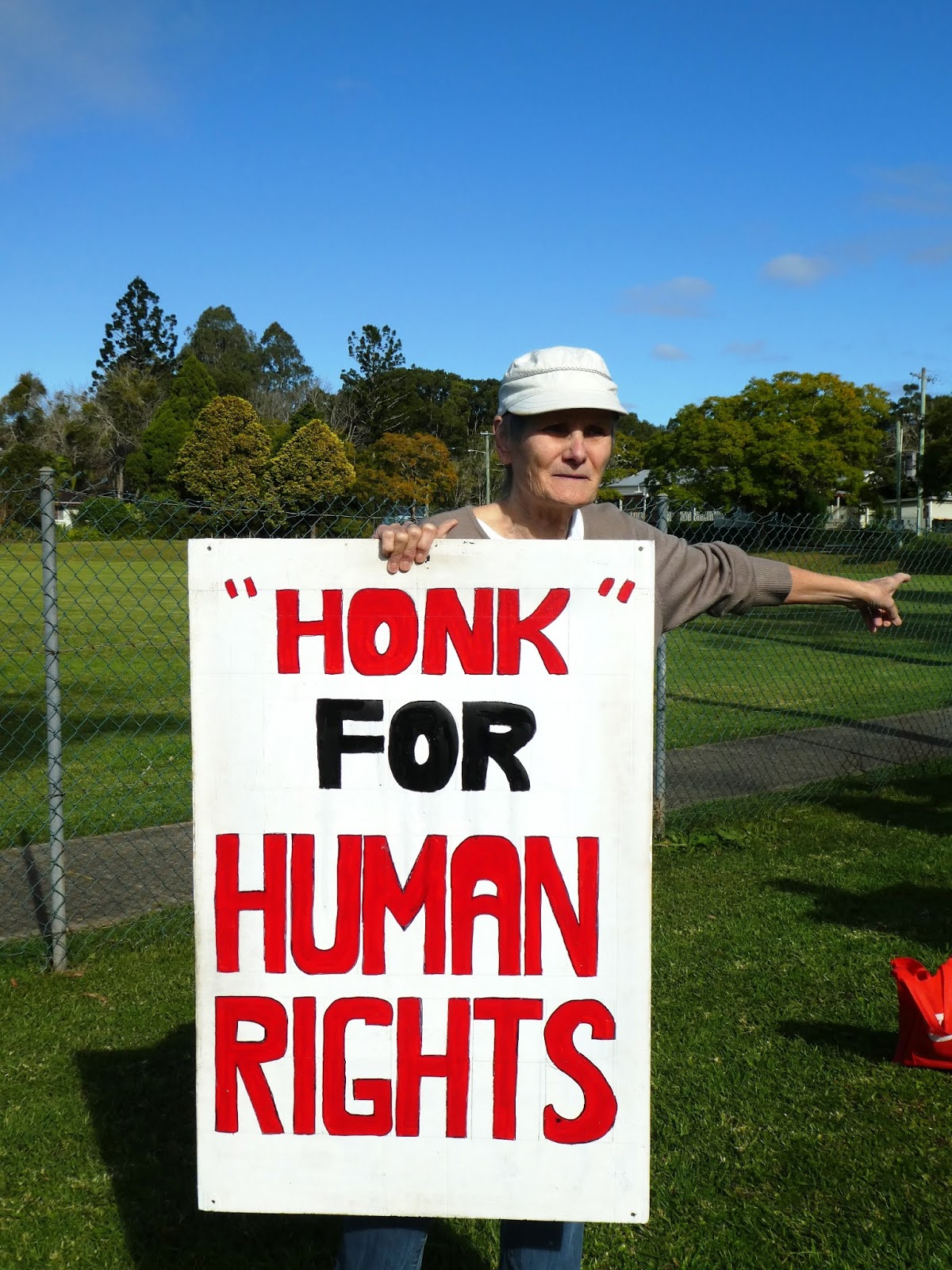
A Demonstration by RAR (Rural Australians in Support of Refugees) gets the thumbs up from passing motorists.

  The item below was printed on the Bellingen Courier Sun web site

Asylum Seeker Rights
Last weekend marked the seventh anniversary of the Rudd government’s announcement that people arriving in Australian waters seeking asylum would be detained in offshore detention and would never be allowed to settle in Australia. As a result of that momentous decision, thirteen men have died in offshore detention, hundreds have suffered both physical and mental torment, families have been separated and lives have been ruined.

Refugee rights
Seven years later, some 400 men, women and children continue to be trapped by our government in PNG and Nauru.  Hundreds more are held in detention in Australia. Some 120 people are stuck in hotels in Brisbane and Melbourne, having been transferred to Australia for urgent medical treatment, which many of them have yet to receive.

Our government has completely abrogated its responsibilities to fulfil its obligations under the UN Refugee Convention.
It is shameful that our government continues to treat these innocent people with such cruel disdain. They have committed no crime, but, unlike convicted criminals, they have no release date from their pain and punishment. Across Australia at the weekend, thousands

of refugee supporters participated in peaceful demonstrations to protest at the government’s cruel intransigence.

Add caption


Our local demonstration in Bellingen on Saturday attracted more than twenty supporters, who lined Waterfall Way with their placards and banners. The support from passing motorists was overwhelmingly supportive of the action.  The organizer of the demonstration, Mike Griffin, explained: “We believe that, in spite of all the other difficulties that we are all facing at the moment, it is still important to remind the public about what the government is doing in our name. This is a cruel, inhumane and unlawful policy that the government could bring to an end within weeks, if it had the political will to do so. It should accept the New Zealand government’s offer to accept 150 refugees immediately, and commit to resettling the remaining refugees and asylum seekers by the end of the year. They have suffered enough.”


3.7.20

Bello Nambucca RAR newsletter 23 June 2020


Hani Abdile’s Refugee Week Story

Aged just 25, Hani is the Refugee Advice and Casework Service’s new ambassador. After leaving Somalia and coming to Australia six years ago, she has achieved so much. She has learned English, published a book of 43 short poems and started a degree in journalism. She has also received numerous awards for her community work. Here is, in brief, her story:

 “My name is Hani and I’m from Somalia, a country which has faced decades of unrest. I had no choice but to leave, so I came to Australia to seek protection. The journey was long and I spent 8 days on a boat before making it to Christmas Island. Life on Christmas Island was a mix of emotions. Sometimes it was great and I could forget the past, but other times it was a fence full of tears. It was challenging, but I had to keep going.
Eventually, I was able to leave Christmas Island and come to Sydney, where I found home, family and friends. But as I am on a temporary protection visa, it’s really hard to plan the future. I hope for the best and plan for the worst. Many people on these visas will feel the same. You never know when the day will come when your visa might be taken away.
People often ask me how they can help refugees. My answer is to listen to what they have to say. People often want to hear the tragic parts of our stories, but it’s important to acknowledge the other parts of our lives too. RACS was a place where I was heard and supported to rise. That is why I’m proud to be a RACS ambassador.

The world is full of hope. It’s full of obstacles and it’s full of great things. With kindness, we can all live in harmony.”

 
That is surely such a powerful and inspiring message for us all.

Nhial Deng’s Refugee Week story 
Nhial Deng, 21, fled Ethiopia 10 years ago, and has spent the last decade living in the UNHCR Kakuma refugee camp, Kenya, in a five-room compound with 18 people. Nhial explains to a UNHCR worker:

“Our village was attacked by militias. People were killed in front of me and houses were burning. We had no choice but to flee. Two of the families I arrived at Kakuma with are from my village, but everyone ran in different directions, including my own family, and I lost contact with them.
When I first came here, I had lost hope. I was frustrated. I was devasted. Now, my hopes for a brighter future are stronger than my fear of failing. I’m now doing so many things.
Firstly, running my social media marketing business StepUp.One. Most of the night I’m writing my novel and reading non-fiction and biographies of people who inspire me. By day, I’m studying information and communications technology, and media.

I’m also an education consultant for Tech Action Group Global. I manage Project Kakuma, where children from 21 primary schools in the camp learn computer skills taught by over 100 teachers worldwide through Skype.
We empower young people for when they return, to rebuild and contribute to their country.”


What an inspiration!
 
#refugees, #asylumseekers, #climaterefugees, #refugeeweek


UNHCR Global Trends Report
The latest UNHCR annual Global Trends Report was published last week, and it makes difficult reading. The report shows that an unprecedented 79.5 million people were displaced as of the end of 2019. UN High Commissioner for Refugees, Filippo Grandi writes:

 “People cannot be expected to live in a state of upheaval for years on end, without a chance of going home, nor a hope of building a future where they are. We need a fundamentally new and more accepting attitude towards all who flee, coupled with a much more determined drive to unlock conflicts that go on for years and that are at the root of such immense suffering.”

Eight things you need to know about forced displacement today

  • At least 100 million people were forced to flee their homes in the past decade, seeking refuge either in or outside their countries.
  • Forced displacement has almost doubled since 2010 (41 million then vs 79.5 million now).
  • 80% of the world’s displaced people are in countries or territories affected by acute food insecurity and malnutrition.
  • More than three quarters of the world’s refugees (77%) are caught up in situations of long-term displacement – for example the situation in Afghanistan, now in its fifth decade.
  • More than eight of every ten refugees (85%) are in developing countries, generally a country neighbouring the one they fled.  
  • Just five countries account for two- thirds of people displaced across borders: Syria, Venezuela, Afghanistan, South Sudan and Myanmar.
  • Global Trends Report counts all major displaced and refugee populations, including the 5.6 million Palestine refugees who fall under the care of the United Nations Relief and Works Agency for Palestine.
  • The 2030 Sustainable Development commitment of “leaving no one behind” now explicitly includes refugees.
To read a summary of the report, simply Google UNHCR Global Trends report.
Check out the index of subjects on our blog http://bellorar.blogspot.com.au
It includes articles from many sources and letters to politicians and newspapers.
This newsletter is sent to >670 recipients
(579 likes)
Twitter Account @RARBellingenNam
Email address bellingen.rar@gmail.com

The National RAR web site is at  www.ruralaustraliansforrefugees.org.au 
The National RAR facebook site is at  RAR Facebook
World Refugee Week 2020
We could be forgiven for not noticing that last week was World Refugee Week. To some extent, we could put this down to our shared preoccupation with the COVID-19 pandemic and the hardship that it has created for communities across Australia.
  But that’s only part of the story. Where were our political leaders, of all stripes, during the past week? Did anyone pick up any references by politicians to World Refugee Week, and the importance of recognising the plight of the more than 70 million people around the world who are currently displaced by wars, internal conflicts and famine?

Where was the mainstream media during World Refugee Week?
The sad reality seems to be that we really did have to go looking for news and stories about Refugee Week. The stories are there in:

The Saturday Paper, in Eureka magazine, in the annual report from UNHCR, and from a number of refugee organisations – The Asylum Seekers Centre; the Refugee Advice and Casework Service; and The Asylum Seekers Resource Centre.

We share with you below some of the reports and stories that have been published during the past week, which highlight the daily struggles of refugees and asylum seekers in Australia, and the plight of refugees around the world, displaced by war and internal conflict.